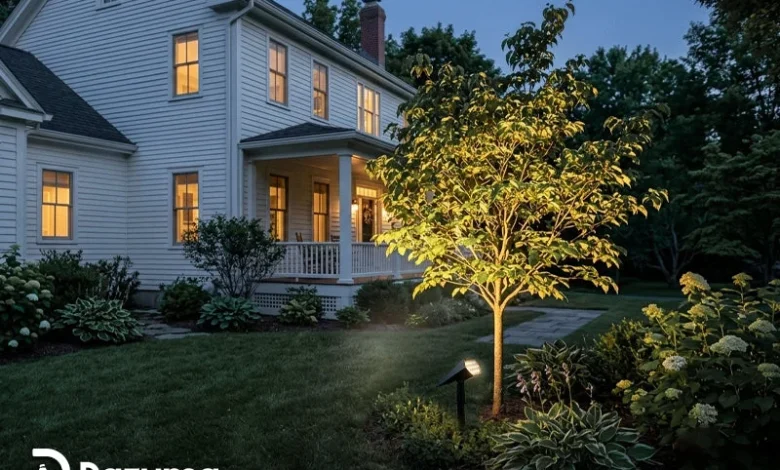
Outdoor lighting can bring those features back, but the best results rarely come from making everything brighter. Effective landscape lighting is selective. It guides movement where necessary, reveals a few important focal points, and allows some areas to remain naturally dark.
Spotlights are especially useful because they allow homeowners to direct illumination toward a particular tree, wall, sculpture, or architectural detail. When combined with softer path and ambient lighting, they can give a garden much more depth without creating the feeling of a brightly lit commercial space.
Start With the Features Worth Seeing at Night
Before choosing fixtures, walk around the garden and identify the features that give the property its character.
These might include a mature tree, textured stone wall, architectural column, water feature, sculpture, or an especially attractive planting bed. The important point is to choose only a few.
If every tree, shrub, wall, and garden ornament is illuminated equally, nothing becomes a focal point. The landscape can begin to feel flat because there is no visual hierarchy.
Instead, select one or two primary features and perhaps a few smaller supporting elements. These become the nighttime structure of the garden.
Build the Lighting in Layers
Landscape lighting works best when several types of illumination perform different jobs.
Path lights can make walking routes easier to follow. Step lights can reveal changes in elevation. Bollards may define larger paths or driveway edges, while spotlights can create stronger visual emphasis around selected plants and architectural features.
Homeowners comparing a broader range of landscape lighting can benefit from looking at these different fixture types as parts of one system instead of selecting one style and repeating it across the entire yard.
The fixtures do not need to match exactly. Similar finishes, light colors, and proportions can create enough visual consistency while allowing each fixture to perform a different function.
Use Spotlights to Highlight Trees
Trees are among the most effective features to illuminate because their shape changes dramatically when lit from below.
A spotlight positioned near the base can reveal the texture of the trunk and draw attention upward into the canopy. Moving the fixture farther away generally creates a broader effect, while positioning it closer to the trunk produces stronger shadows and more dramatic texture.
Experiment before fixing the position permanently. A change of only a few feet can completely alter the appearance of the tree.
Large trees may also benefit from more than one light positioned from different directions, but restraint is still important. The aim is to reveal the form of the tree rather than illuminate every branch evenly.
Use Spotlights for Architectural Details
Spotlights are not limited to plants.
Stone walls, columns, textured cladding, entrance features, and other architectural elements can become strong nighttime focal points when illuminated carefully.
Homeowners looking at different Spotlights should pay attention to adjustability and beam direction because these characteristics determine how precisely the light can be aimed at a particular feature.
A narrower beam can emphasize a column or small architectural element, while a wider beam may work better across a larger wall surface.
Always check that the fixture is aimed at the intended surface rather than beyond it into windows, neighboring properties, or open sky.
Avoid Pointing Lights Directly at People
One of the biggest differences between attractive landscape lighting and uncomfortable outdoor lighting is glare control.
A spotlight may look subtle when viewed from behind, but someone approaching it from another direction may see the bright source directly.
After positioning a fixture, walk through the garden from several directions. Check the view from paths, patios, driveways, and seating areas.
If the source is clearly visible, try changing the angle, moving the fixture, or using planting and architectural features to help conceal it.
The best outdoor lighting often allows people to notice the illuminated object before they notice the fixture producing the light.
Keep Path Lighting Softer Than Accent Lighting
Path lighting has a different purpose from spotlighting.
A pathway needs enough light for people to understand where they are walking, but it should not compete visually with the garden’s focal points.
Lower output and downward-directed fixtures are often suitable. Rather than placing lights directly opposite one another at perfectly regular intervals, consider staggering them around curves, steps, and planting.
This creates more natural pools of illumination while preventing the walkway from looking like a runway.
Keeping circulation lighting subtle also gives spotlit trees and architectural features more visual impact.
Think About Foreground, Middle Ground, and Background
A useful way to create depth is to think of the garden almost like a photograph.
The foreground may include the patio or plants closest to the house. The middle ground might contain a path or planting bed, while the background could feature a mature tree or boundary wall.
If only the foreground is illuminated, the garden may appear smaller after dark because everything beyond the patio disappears.
Adding one softly illuminated feature deeper in the yard can extend the view significantly. This is especially effective when the garden can be seen through large living-room windows or sliding doors.
Use Warm Light for a More Natural Effect
Color temperature affects how materials and plants appear at night.
Warm illumination generally works well in residential landscapes because it complements timber, stone, brick, and green foliage while creating a more relaxed atmosphere.
Very cool white lighting can look crisp and modern, but using it extensively may make a garden feel harsher than intended.
Consistency is also important. If the pathway produces warm light while the tree spotlights appear noticeably blue, the landscape can feel disconnected.
When adding new fixtures to an existing system, compare the color temperature of nearby lights before making a final choice.
Plan for Plants to Grow
Outdoor lighting needs to adapt to a landscape that is constantly changing.
A small shrub may eventually grow over a path light. Tree branches can expand into the beam of a spotlight, and ornamental grasses may obscure fixtures positioned too close to them.
Leave enough room for future growth and make sure adjustable lights remain accessible.
It is also worth reviewing fixture angles once or twice a year. What worked perfectly when a tree was smaller may need adjustment several seasons later.
Do Not Forget the View From Inside
Outdoor lighting influences indoor spaces too.
Without any garden illumination, large windows can become dark reflective surfaces at night. A few carefully lit trees or landscape features beyond the glass can extend the visual depth of the room.
At the same time, check that spotlights are not shining into bedrooms, living rooms, or neighboring windows.
Stand inside the home after dark and look outward before considering the installation complete. This often reveals glare problems that are difficult to notice while standing in the garden.
Final Thoughts
Good landscape lighting is not about illuminating every part of the yard. It is about deciding what deserves attention and using the right type of light to reveal it.
Begin with safe movement along paths and steps, then select a small number of trees, walls, or architectural features to highlight. Use spotlights precisely, control glare, maintain consistent light color, and allow areas of shadow to remain between the illuminated elements.
When light and darkness are balanced carefully, even a relatively simple garden can gain depth, structure, and character after sunset without becoming excessively bright.