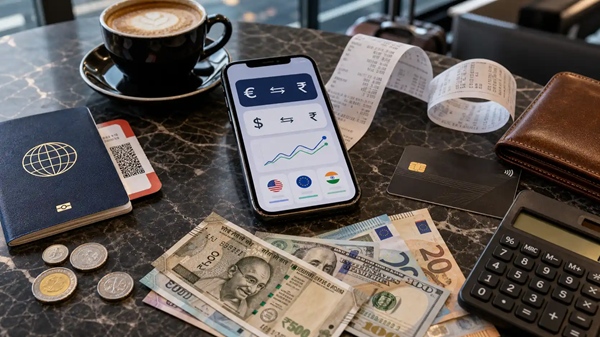
If you have ever returned from a trip abroad and discovered your bank statement filled with various charges you did not expect, cross-currency fees are likely the culprit. Most travellers do not notice them until the damage is done, and by then, hundreds or even thousands of rupees have already left the account. Banks rarely explain them clearly at the time of card issuance, and the fee structure itself is designed in a way that makes it difficult to spot in real time.
For frequent international travellers, the cumulative cost over a year can be surprisingly high. Understanding what these charges are, how they work, and which card choices can eliminate them is worth a few minutes of your time before your next trip.
Understanding cross-currency fees in forex card transactions
Before you can dodge a fee, you need to understand what a cross-currency fee is in international cards.
When you use an international debit or credit card to pay in a foreign currency, your card network converts the amount from that currency into your home currency, Indian Rupees, in most cases. The bank or card issuer adds a percentage on top of the base exchange rate for this service. That percentage is called a cross-currency fee, also referred to as a forex markup or foreign transaction fee.
On most traditional bank cards, this sits between 3% to 5% per transaction. On some premium or travel-specific cards, it goes even higher.
The fee is rarely advertised upfront. It tends to appear as a line item on your statement after the fact, or worse, it gets quietly folded into the exchange rate itself, making it nearly invisible unless you compare the rate you received against the live interbank rate.
Breaking down forex card conversion costs
The math behind these fees is simpler than card issuers would like you to think.
The base exchange rate
Every currency conversion starts with the interbank rate, the rate at which large banks exchange currencies among themselves. This is the “true” rate you see on Google or XE.com. As a retail customer, you will never receive this rate exactly. What you receive is this rate plus whatever spread your card issuer applies.
Understanding the markup layer
Forex card conversion charges typically work in two layers. The first is the network rate, set by Visa or Mastercard. This is already slightly above the interbank rate. The second is your bank’s additional markup on top of the network rate. If your card carries a 2.5% markup and you spend ₹1,00,000 abroad, you are paying ₹2,500 extra, purely in conversion fees. Spend ₹5 lakh on a longer trip, and that figure becomes ₹12,500.
An illustration
Say the live USD/INR rate is 92.00. Your bank’s forex card applies a 5% markup. The effective rate you get is 92.00 × 1.05 = 96.60. Every dollar you spend costs you ₹4.60 more than the prevailing rate. It feels minor per transaction, but across hotel stays, meals, shopping, and transport, the conversion charges compound fast.
Situations that trigger high cross-currency fees
Not every international spend triggers the same fee structure, and knowing where the costs spike helps you plan better.
Dynamic Currency Conversion (DCC)
When a foreign merchant or ATM offers to charge you in your home currency instead of the local one, this is called Dynamic Currency Conversion (DCC). It feels convenient, but it almost always comes with an inflated rate applied by the merchant’s bank, on top of your own card’s markup. Declining DCC and paying in the local currency is almost always the cheaper option.
ATM withdrawals abroad
Cash withdrawals from foreign ATMs often attract a flat fee per transaction plus a percentage-based cross-currency fee. If you withdraw small amounts frequently, the flat fees multiply. Consolidate your withdrawals where possible.
Online purchases from foreign merchants
If you are sitting in Delhi buying something from a US-based website, your card issuer treats that as a cross-currency transaction and applies currency conversion charges accordingly. This catches a lot of online shoppers off guard.
How to avoid or significantly reduce these fees
Reducing cross-currency fee means choosing the right payment option and using it correctly.
Choose a zero forex markup card
The most direct solution is a card that does not charge a markup at all. Niyo’s zero forex markup card lets you spend in 180+ countries at live Visa exchange rates, with no additional bank markup layered on top.
Always pay in local currency
As mentioned with DCC above, always opt to pay in the local currency of the country you are in. This removes one unnecessary conversion layer and keeps your total currency conversion charges lower.
Plan your ATM use
Minimise the number of ATM withdrawals you make internationally. Each trip to the machine can trigger both a flat fee and a percentage-based cross-currency fee. Where possible, use your card for direct purchases instead.
Monitor live rates before large transactions
Apps and forex cards that show live exchange rates, including the Niyo app, which has a built-in currency converter, help you time larger purchases when the rate is more favourable.
Conclusion
Cross-currency fees are not complicated, but they are easy to underestimate. Understanding what a cross-currency fee is and how the conversion charges are calculated puts you in control of your travel spending rather than leaving you to discover unpleasant surprises on your statement.
If you travel even a few times a year, switching to a zero markup option like the Niyo zero forex markup card is one of the most straightforward ways to hold on to money that would otherwise quietly disappear in fees. The exchange rate itself is something none of us controls. The markup on top of it is.